A simple mood tracker for people who hate journaling
You do not need to write a page about your day. A useful record can be one score, one emotion, and one small clue about what was happening.
Published 3 August 2026 · 7 minute read · By the Vibbrancy team
Journaling is often presented as the obvious way to understand your emotions. For some people it is. For others, the blank page feels like homework, the habit disappears after three days, or writing in detail makes an already busy evening feel heavier. That does not mean reflection is unavailable to you. It means the format may be too demanding.
Mood tracking uses a smaller unit of reflection. Instead of reconstructing the whole day, you record enough information to help your future self remember it. The goal is not a complete diary. It is a trail of useful clues.
What makes a mood tracker simple?
A simple mood tracker asks for little enough that you can finish an ordinary check-in without deciding what to write. Paper, a note on your phone, or an app can all work. The useful test is whether the method keeps the same small choices each time and leaves longer notes optional.
Before choosing an app, check what remains available without a subscription, whether an account is required, where entries are stored, and how export and deletion work. Our free mood tracker app checklist gives you nine questions you can use without ranking one provider above another.
Read the video transcript
- You do not need to journal about your whole day.
- Start with three choices: a rough score, one emotion, and one context clue.
- A synthetic example records 3 out of 5, relieved, and sent the email.
- Notes are optional.
- After a missed day, restart at the next check-in. Do not reconstruct.
- A short record is a trail of clues, not a verdict. Reduce or pause if tracking becomes distressing.
Replace the blank page with three choices
For one week, make each check-in contain only:
- A score: roughly where your mood sits right now.
- An emotion: one word that is more precise than “good” or “bad.”
- A context clue: sleep, work, movement, people, health, or another short tag.
Notes are optional. If a sentence arrives naturally, write it. If not, stop after the three choices. A short, honest entry is more useful than an ambitious routine you avoid.
The seven-day no-journal experiment
- Choose one daily cue, such as plugging in your phone at night.
- Record one score, one emotion, and one context clue.
- Skip the written note unless there is something you genuinely want to preserve.
- Do not correct yesterday’s answer using today’s memory.
- After seven days, look for one useful question—not a diagnosis or a final conclusion.
Free seven-day challenge
Seven tiny prompts, no private sharing
Keep every answer on your own device or paper. If you want to share that you finished, use the neutral completion tile below. It contains no mood score, emotion, context clue, streak, account name, or journal text.
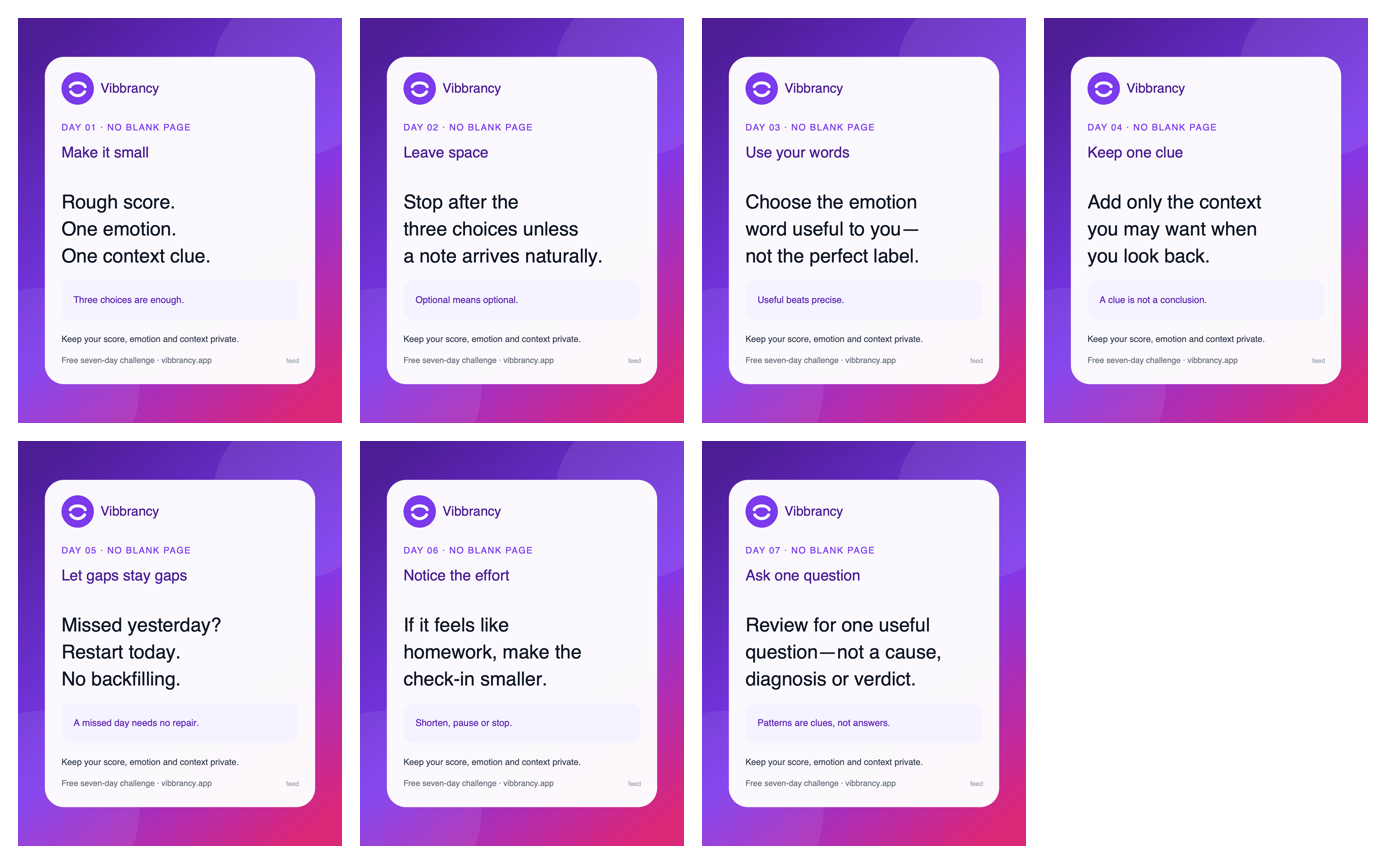
- Day 1 · Make it smallRecord a rough score, one emotion, and one context clue.
- Day 2 · Leave spaceStop after the three choices unless a note arrives naturally.
- Day 3 · Use your wordsChoose the emotion word that is useful to you, not the perfect label.
- Day 4 · Keep one clueAdd only the context you may want when you look back.
- Day 5 · Let gaps stay gapsIf you missed yesterday, restart today without reconstructing it.
- Day 6 · Notice the effortReduce the check-in if tracking is starting to feel like homework.
- Day 7 · Ask one questionReview for one useful question, not a cause, diagnosis, or verdict.
Download all seven daily cards
Use one prompt at a time or share the unfilled method. The ZIPs include editable SVGs, ready-to-post PNGs, a reviewed caption, and alt text. They contain no completed score, emotion, context, streak, account name, or journal text.
Keep the seven check-ins private
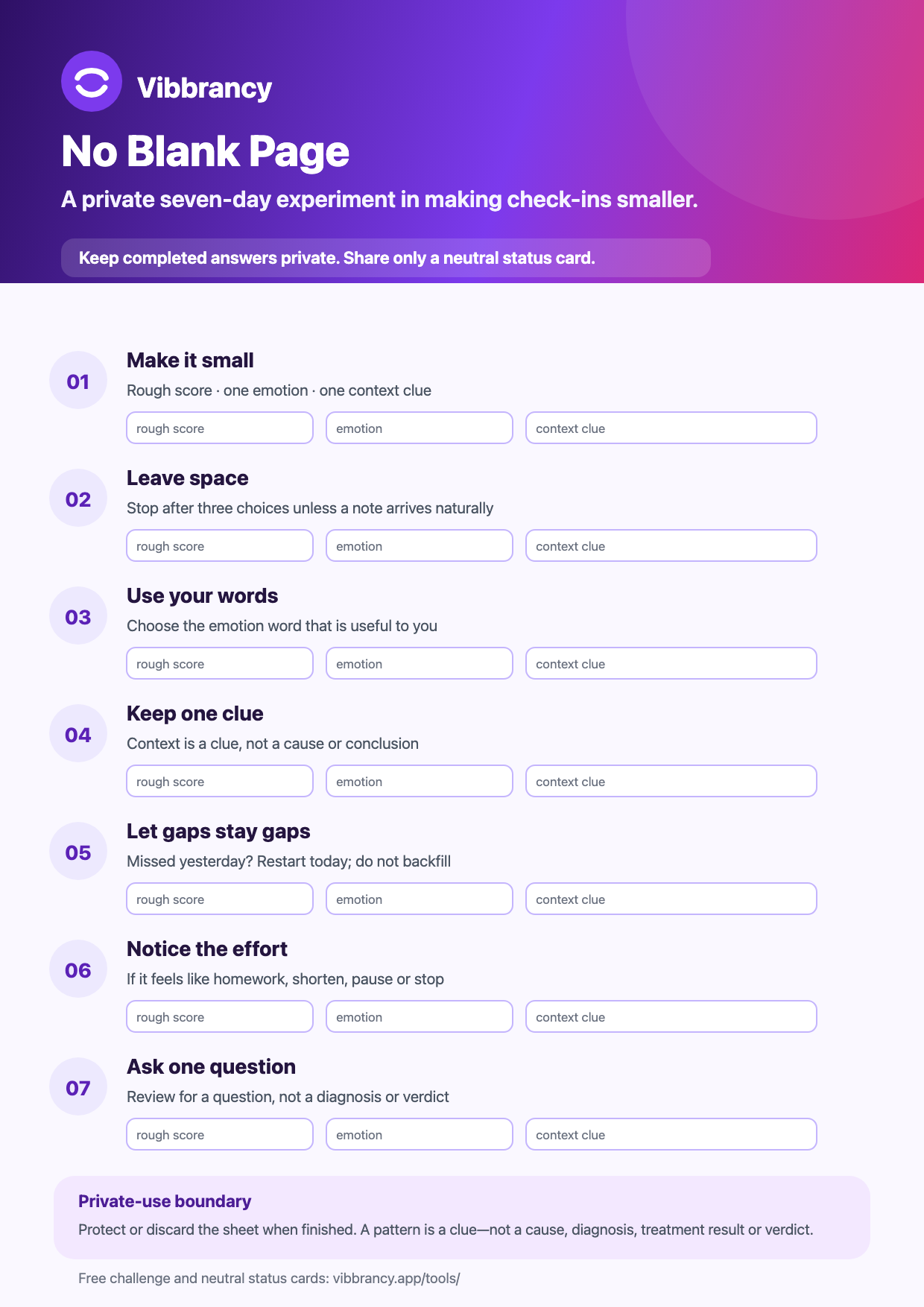
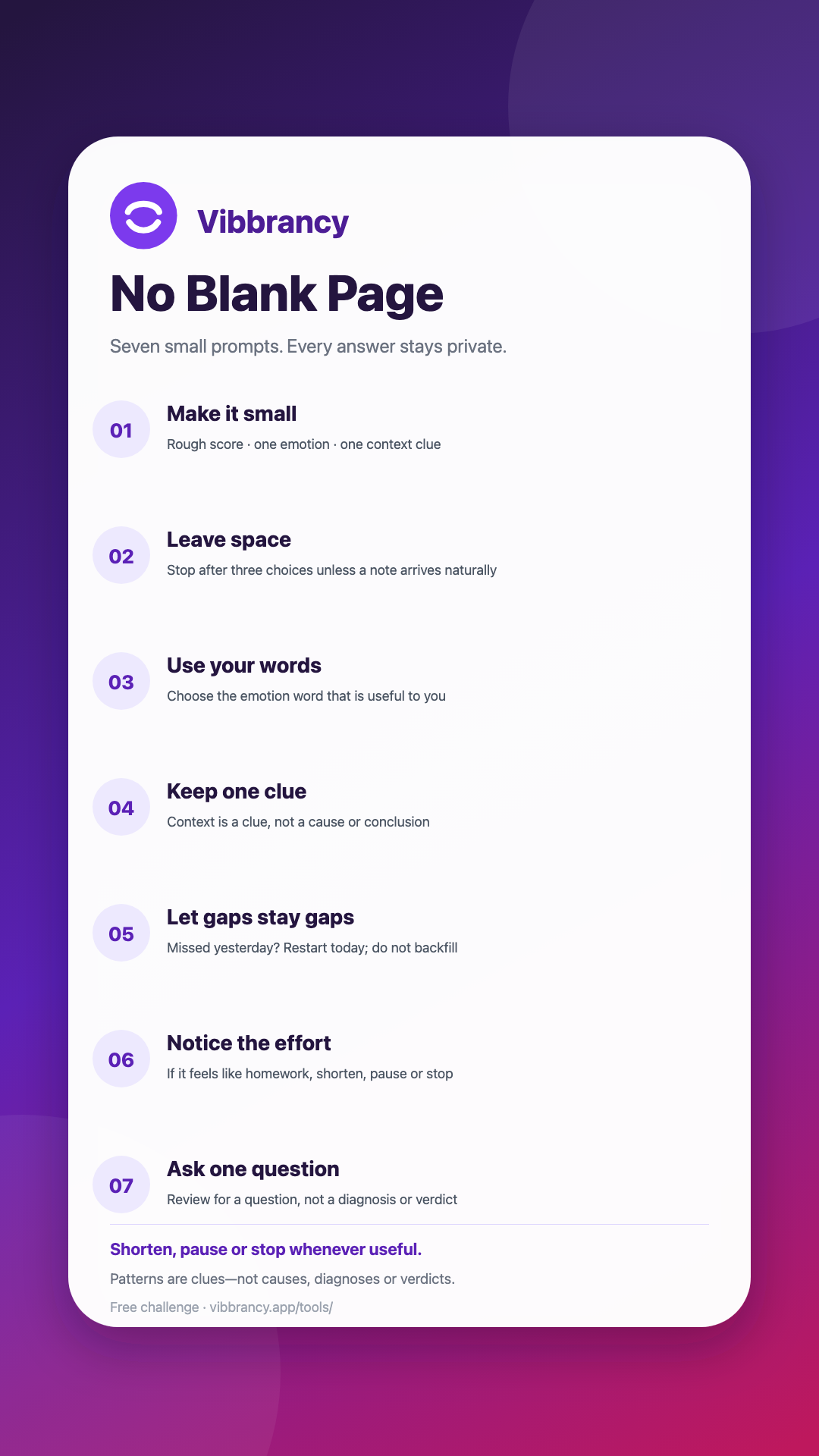
Print the one-page sheet or save the prompts-only phone wallpaper. Both work without installing Vibbrancy, creating an account, entering an email address, or uploading an answer. The wallpaper contains prompts only; the printable is for private use.
Gaps, pausing, and stopping are allowed. Protect or discard a completed sheet, and use the neutral status cards below if you want to share the method without sharing a score, emotion, context clue, journal entry, or health detail.
Share where you are, not what you recorded
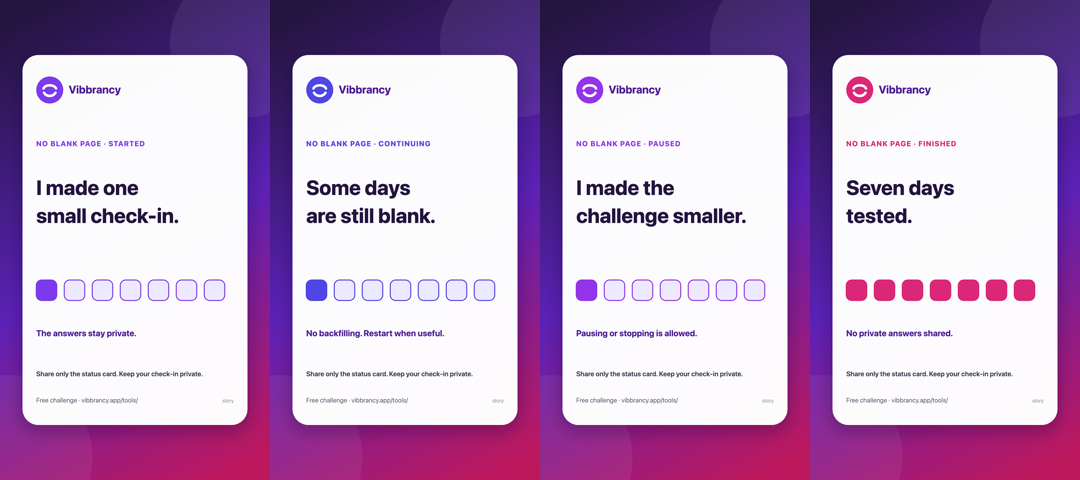
Choose started, continuing with gaps, paused, or finished. The neutral status pack includes editable and ready-to-post feed and Story cards. None reveals a score, emotion, context clue, journal entry, health detail, or account identity.
Pausing and stopping are allowed. The cards make no streak, treatment, benefit, research, or wellbeing-outcome claim.
Download all neutral status cards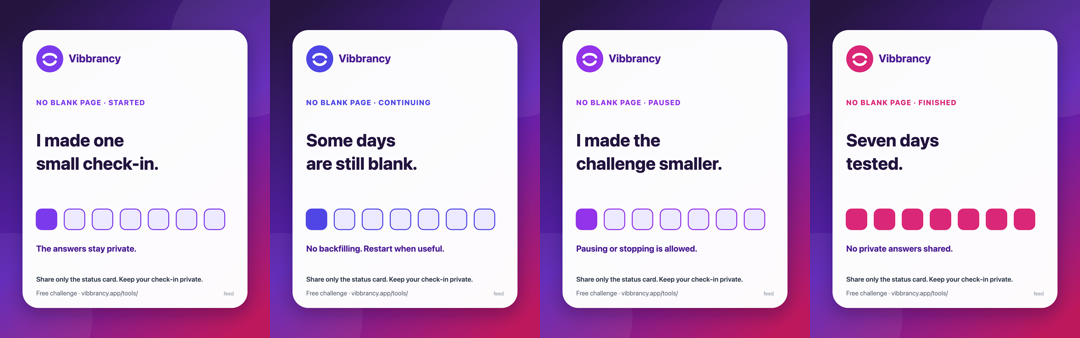
Share the challenge with a community or newsletter
This handoff kit is made by the Vibbrancy team for moderators, newsletter editors, and community organisers who want to review the free challenge before sharing it. It includes an editable card, ready-to-share PNG, one-page PDF, alt text, short listing, longer community post, and a critique-not-coverage note.
Check the rules of each community first and disclose the Vibbrancy affiliation. Do not request completed entries or present the prompts as diagnosis, treatment, research, endorsement, proof of benefit, or a guaranteed outcome. People may shorten, pause, or stop the challenge.
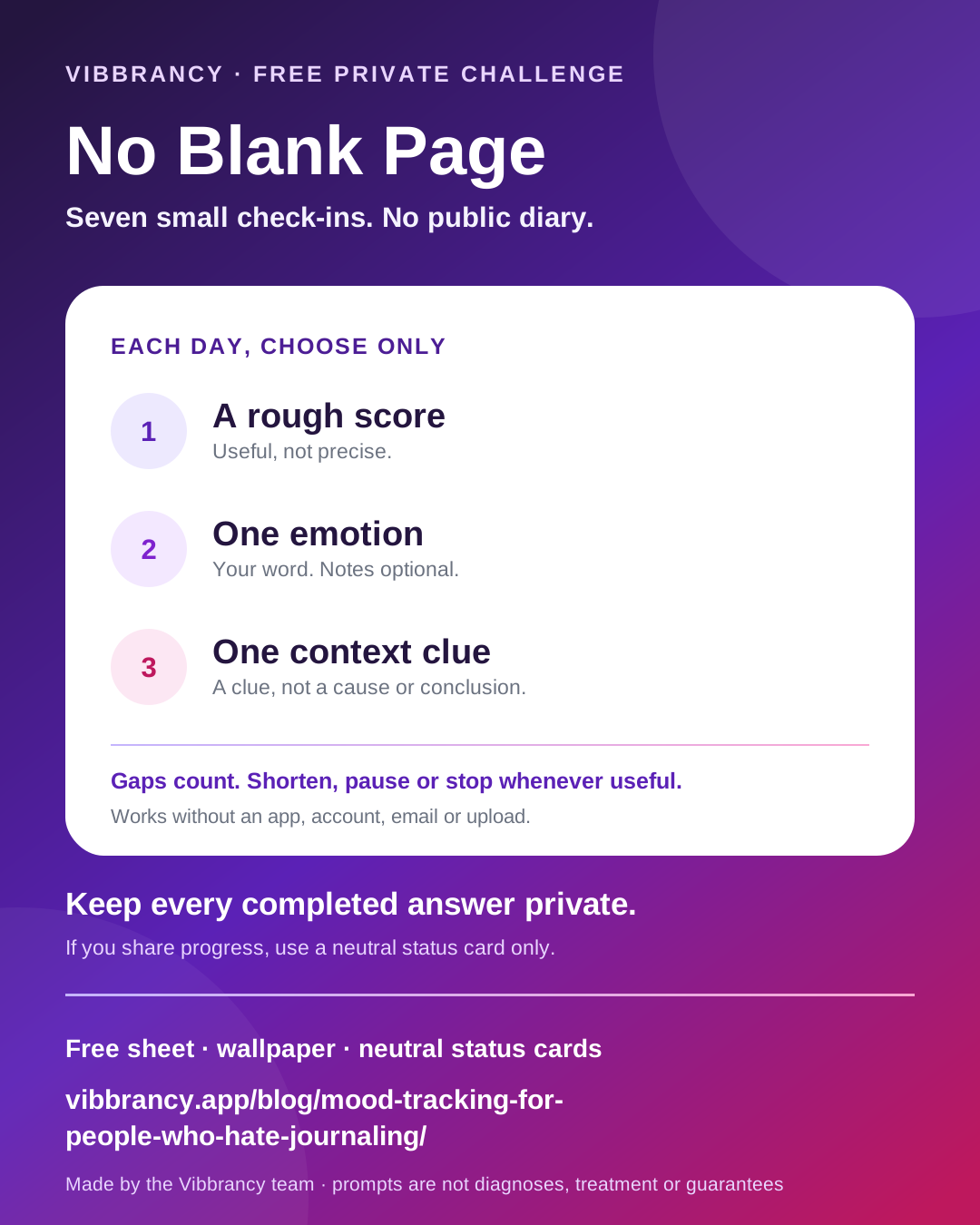
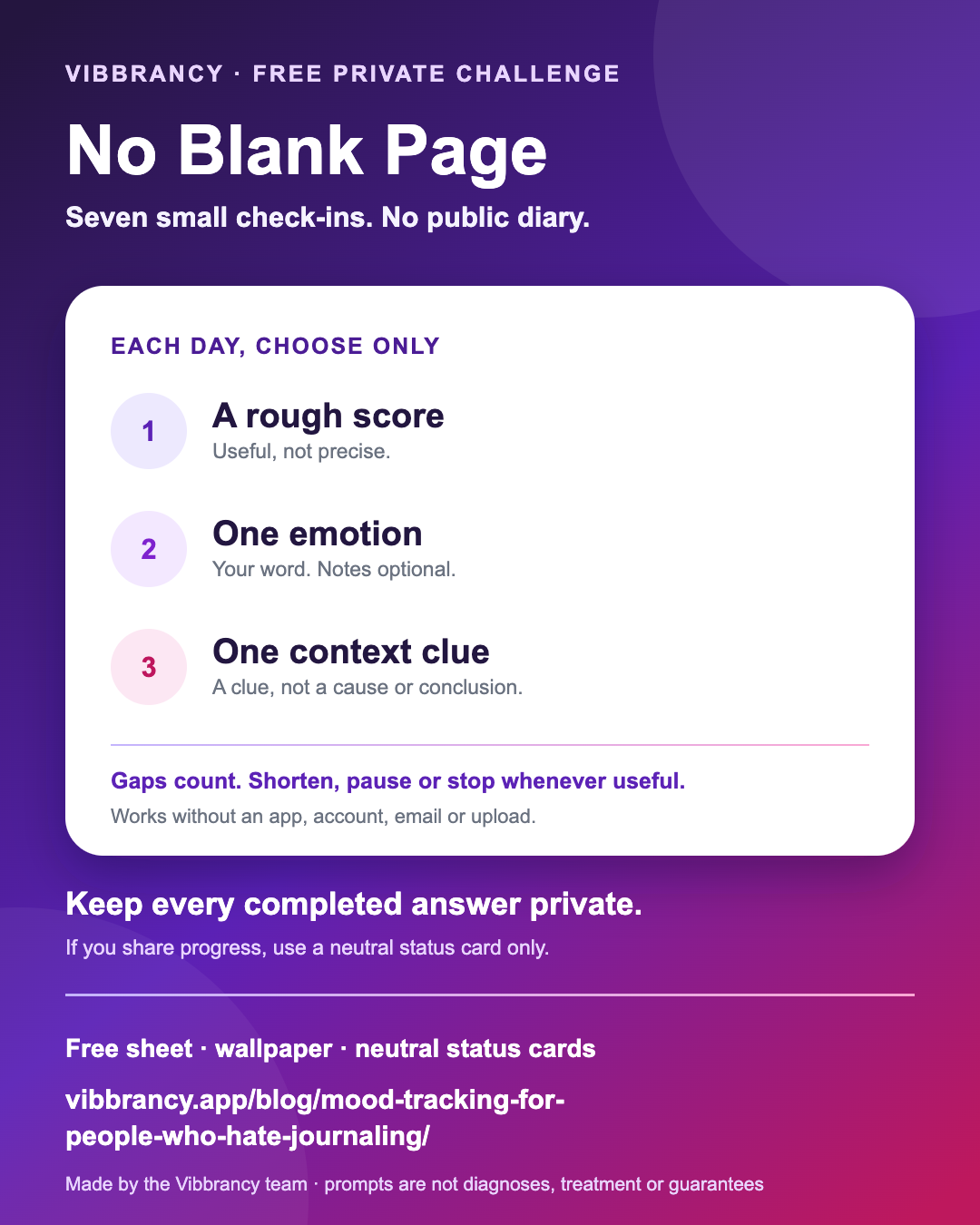
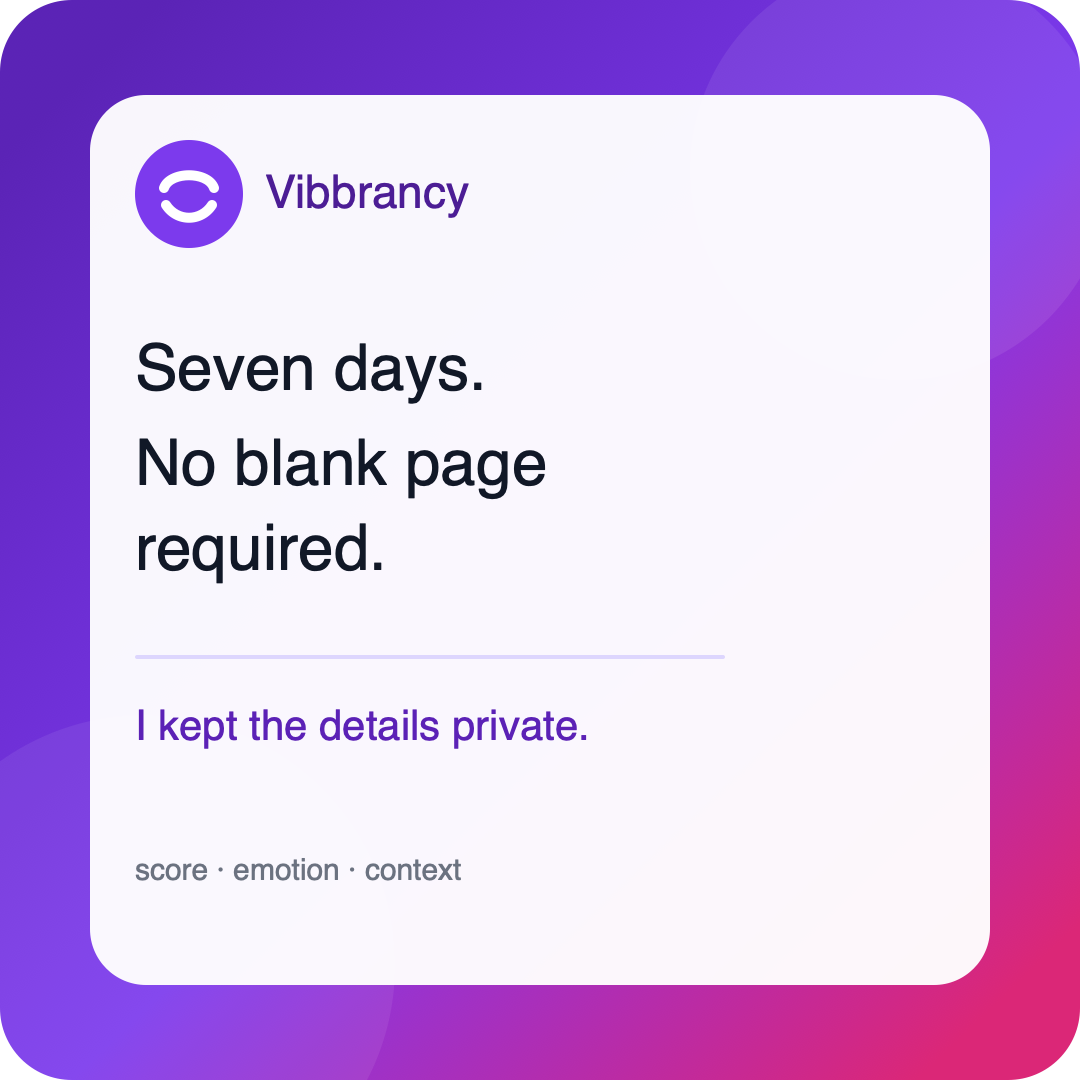
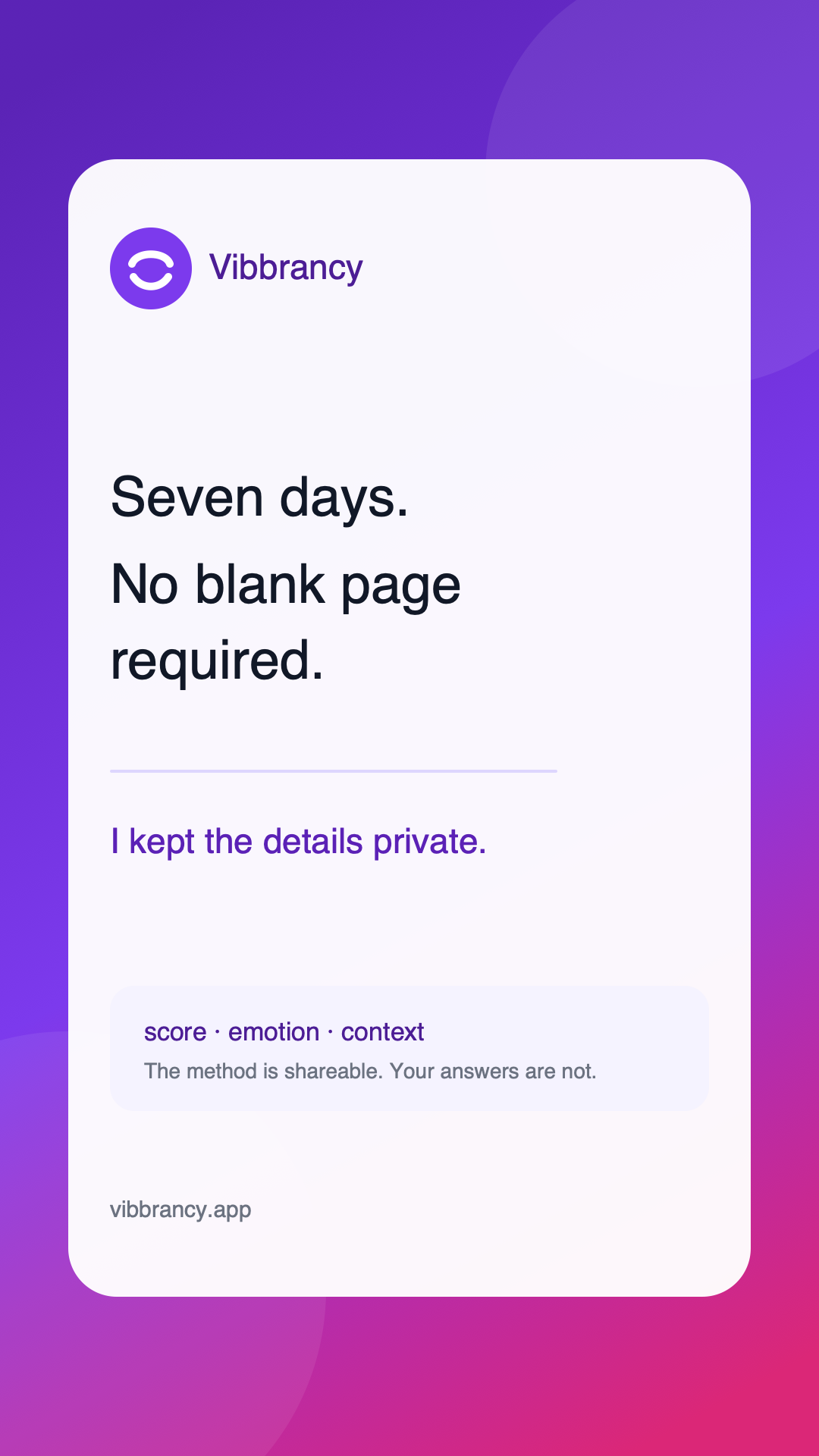
Vibbrancy does not ask you to upload challenge answers. These image files are served as ordinary public downloads; no form, email address, or account is required.
Ask smaller questions when you review
A week of check-ins cannot prove that sleep, work, exercise, or another person caused a mood change. It can help you notice what deserves attention. Try questions such as: Which days are difficult to remember without the log? Did the same emotion appear in different situations? Is there a context tag worth watching for another week?
Avoid turning a short record into a verdict about yourself. One low score is an entry, not an identity. A repeated pattern is a prompt to look more closely, not proof of cause.
Make the habit easier to restart
Missing a day does not spoil the experiment. Resume at the next natural cue without filling the gap from memory. Backfilling often records the story you tell now rather than how the moment actually felt.
If even three choices feel like too much, begin with one mood score. If the check-in starts making you monitor yourself constantly, reduce the frequency or pause. Reflection should serve your life rather than become another performance target.
If you want a ready-made version, the free Three-Field Check-In Kit includes a printable card, phone wallpaper, and copyable Notes template. It works without installing Vibbrancy, and completed entries should stay private.
Choose privacy that matches the subject
A brief entry can still be sensitive. Before using any mood tracker, check whether an account is required, where entries are stored, whether advertising trackers are present, and what changes when cloud sync is enabled. Shorter notes reduce what you record; they do not remove the need to understand where that record goes.
Our private mood-tracking checklist gives you six questions to ask any provider. You can also compare the different jobs done by a mood tracker and a journal before deciding whether either belongs in your routine.
Know when a tracker is not enough
Mood tracking is a reflection aid, not treatment, diagnosis, or crisis support. If your mood changes are severe, persistent, or worrying, consider speaking with a qualified professional. If you may be in immediate danger, contact local emergency or crisis services rather than relying on an app.